| Your Hidden Talent |
 You tend to be full of new ideas and potential - big potential. Ideas like yours could change the world, if you build them. As long as you don't stop working on your dreams, you'll get there. |
Hat-tip: Waterfall
| Your Hidden Talent |
You tend to be full of new ideas and potential - big potential. Ideas like yours could change the world, if you build them. As long as you don't stop working on your dreams, you'll get there. |
 I can’t remember another time I’ve had the hate on for my blog like I do now! This is unprecedented. It’s like I’ve turned Jekyl– or is it Hyde (whichever is the nasty one).
The weekend just past had some wonderful moments. (We traveled to Kelowna - 4 hours- to visit with hubby’s sis Marilyn and bro-in-law Don who came all the way from Thunder Bay, Ontario.)
Friday night was a surprise planned by Arnold (hubby’s brother) who lives there. So 4:30 found us at Shelter Bay marina, boarding the Nicola d’Italia for a Classic Woodenboat Cruise.
For four (plus!) hours we toured Lake Okanagan on this beautifully restored 1965 wooden vessel. Captain Doug not only manned the boat, but also cooked us a steak dinner which we ate to the crooning of Tom Jones and other oldies. Even the weather eventually cooperated. The rain, which had begun around noon, petered out soon after we got on board so we not only had mostly dry sailing, but enjoyed the sunset on the lake.
If you’re ever in Kelowna, check out Doug’s Classic Woodenboat Cruises and Charters. His afternoon cruises stop for a 45-minute swim break, his boat has the jam to pull skis or a tube, he has a karaoke machine on order, and knows all about local fishing (he cut his boating teeth on his dad’s fishboat).
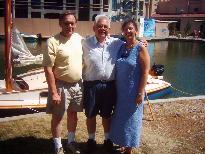
The siblings: Arnold, Ernie and Marilyn - parked in front of an antique sailboat - part of this weekend's antique boat show in Kelowna.

The outlaws: Violet, Don & Daphne - outside the Cherry Festival (why do our teeth look so weird? Must be from sampling all those cherries).
The Senate erupted in a loud cheer as it adopted the Liberal government's Bill C-38, which will give gay and lesbian couples the right to marry in courthouses and city halls across the country..."
[...] The bill will become law when it receives royal assent in a ceremony as early as Wednesday.
[The entire Globe and Mail story]
OTTAWA, July 19, 2005 (LifeSiteNews.com) - Just as Senate approaches the final vote on the gay 'marriage' bill, C-38, Canada's national public radio CBC Radio (THEY BROADAST ON OUR DIME!) has aired a commentary by a retired professor from the Royal Military College calling for state control over religion, specifically Catholicism. While parliamentarians dismissed warnings by numerous religious leaders and experts that such laws would lead to religious persecution, former professor Bob Ferguson has called for "legislation to regulate the practice of religion"
Given the inertia of the Catholic Church, perhaps we could encourage reform by changing the environment in which all religions operate," Ferguson began his commentary in measured tones yesterday. "Couldn't we insist that human rights, employment and consumer legislation apply to them as it does other organizations? Then it would be illegal to require a particular marital status as a condition of employment or to exclude women from the priesthood. "
[...] The former professor pitched his idea as a boon to religious freedom. "We could also help the general cause of religious freedom by introducing a code of moral practice for religions," he said. "They will never achieve unity so why not try for compatibility? Can't religious leaders agree to adjust doctrine so all religions can operate within the code?"
Ferguson, would see religion regulated by provinces in the same way professions are regulated. "I am an engineer so the model I am thinking about is rather like the provincial acts regulating the practice of engineering,".... The different branches: mechanical, electrical, civil and the like have a code of practice that applies to everyone. Why can't religious groups do the same?"
Continuing his comparison Ferguson stated, "I envisage a congress meeting to hammer out a code that would form the basis of legislation to regulate the practice of religion. Like the professional engineers' P.Eng designation, there would then be RRPs (or registered religious practitioners). To carry the analogy to its conclusion, no one could be a religious practitioner without this qualification."
Ferguson also suggests 'obvious' prohibitions on religion including preaching of 'hate'. "I won't try to propose what might be in the new code except for a few obvious things: A key item would have to be a ban on claims of exclusivity. It should be unethical for any RRP to claim that theirs was the one true religion and believers in anything else or nothing were doomed to fire and brimstone. One might also expect prohibition of ritual circumcisions, bans on preaching hate or violence, the regulation of faith healers, protocols for missionary work, etc.," says Ferguson.
The retired professor concluded his comments aired on CBC yesterday (that would be Monday, August 18th) morning saying, "Now what is the point of proposing this? I do it because I am worried that the separation between church and state is under threat. Religion is important in our lives, but it can become a danger to society when people claim that the unalterable will of God is the basis for their opinions and actions. Yes religion can be a comfort and a guide, but we cannot take rules from our holy books and apply them to the modern world without democratic debate and due regard for the law."(emphasis mine)
This is in regard to a "Commentary" by Bob Ferguson, broadcast Monday, July 18,
2005.
I am frankly shocked and disappointed that the publically-funded CBC would give credibility to such repressive ideas by giving them air time! Do you not realize that thousands upon thousands of Canadians came here to escape just such box-in-religion regimes like Mr. Ferguson advocates.
I used to be a fan of the CBC. But your recent and consistent left-wing and anti-American tack turn me off. This attack on Canadian people of faith, though, with its complete and utter misunderstanding of religion and its role in people's lives goes beyond the pale!
Let Mr. Ferguson have his say. I support his right to say it. But not on the CBC where I’m forced to help pay the bill! I will be doing my best, in the future, to fight for privatization of this propaganda machine.~~~~~~~~~~~~~~~~~~~~~~~~~~~
Hat tip: ProudToBeCanadian
Mr. MacIntyre’s ministry is also characterized by how when he prays for people, they fall under the power of God (sometimes called ‘slain in the Spirit’ – Helen, this will probably sound weird to you... I would have thought the same a few years ago, but my study of the Bible on how God worked in the Old and New Testaments and the results in powerful changed lives has opened me up to it).
You and Me Alone
Take all I have and all I have gained
Lay me bare to the bone
Shake the foundations and see what remains
It’s just You and me alone
Until it’s just You and me alone.
Tear down the borders that I have built
Crush the walls, stone by stone
Destroy my resistance that I hold so strong
It’s just You and me alone
Until it’s just You and me alone.Lay me down, let this place be an altar
Lay me down, let this death be complete
Lay me down, let this song be a marker stone
That others can easily see.
Lay me down, like a drink that is poured out
Lay me down, like a seed that must die
Lay me down, so I can rise in the morning
While the grave clothes fall down at my feet.--Norm Straus c. 2001
Peace comes from God (Romans 1:7) and is an evidence of the rule of the Messiah – whose character as the "Prince of Peace" (Isaiah 9:6) waits to instill the settledness of His own rule in our souls. Just as the saving power of His death and resurrection makes it possible for us to have peace with God (being reconciled to Him, Romans 5:1), and the indwelling of His life and character through the holy Spirit’s work in our lives is intended to help us learn to abide in the peace of God, Jesus said to His disciples, "Peace I leave with you, My peace I give to you" (John 14:27).
Surrender to His will and submission to His Word will bring inner rest, as we allow the peace of God to "rule" in our hearts (Colossians 3:15), that is to let God’s peace act as umpire 1) over decisions that would trouble us, 2) overruling doubts that would disturb us and 3) overthrowing the Adversary’s lies that would defeat or deter us. Perfect peace is available when the heart and mind keep focused on God’s promise, power, and presence. Trust Him. "You will keep him in perfect peace whose mind is stayed on You, because he trusts in You." - Isaiah 26:3
"Art can only be Art by presenting an adequate outward symbol of some fact of the interior life." – Margaret Fuller
Yes. On the one hand, that seems perfectly obvious. In writing (the art we’re discussing here), the works I would call art are simply works that communicate something significant about being human. And when one examines these works – yes, they are surely more than the surface recounting of events.
But as I reread the quote and notice that "Art" is important-looking, as if personified– capitalized as it is – I question, is this little proverb saying that real and genuine Art is something special, rare and hard to attain? (And what is meant by adequate, outward, symbol?) Maybe I’m way off base here, but my formula for making a work of art is really rather simple.
1. You pay attention.
This is trickier than it looks. Because it is so easy to live life as one reads a book – focusing forward, anxious to get to the next scene, forgetting to highlight and flag and scribble in the margins. But to be tuned into your own particular brand of art, it’s necessary to listen and respond to that tiny voice inside your head which says, "This is important. Pay attention here. Mark this spot – or you’ll have a hard time finding it again later."
Someone who is a master at doing this is the Canadian short story writer Alice Munro. When you examine the characters in her stories, they are simple, ordinary people to whom you as a reader may even feel superior. And her plots are frequently mere ripples: a father who is a salesman, takes his kids along on one of his routes, making a detour to visit an old flame ("Walker Brothers Cowboy"), a spinster piano teacher’s annual music recital takes a unexpected turn when a mentally handicapped boy gets up to play ("Dance of the Happy Shades"), a toddler falls into a swimming pool on a summer vacation trip ("Miles City, Montana").
This shows that the things that snag your attention don’t have to be big. It’s the fact that you notice them and ponder their significance which gives them the possibility of becoming art.
2. You deliver the goods.
You make every effort to communicate your truth with honesty, skill and passion (I suppose this is where the adequate comes in, in the quote above). By make every effort I mean the doing of all the stuff the lectures and how-to books tell you, like considering genre, length, point-of-view, voice etc. etc. And then you write, edit and rewrite -- squared.
By your truth I mean colored in the way you personally see, understand and make sense of life. This, of course, is where your world view (Christian or non-) will dye the story.
Here’s how Alice Munro tells the story of the toddler falling into the pool.
She begins with the first-person storyteller relating a spooky childhood memory:"My father came across the field carrying the body of the boy who had drowned." Then she goes on to tell us about this boy, his funeral and how even as a young child, she felt the adults in his life were in some way implicated in his death.
White space here, and then we step into the main story:
"Twenty years or so later, in 1961, my husband Andrew and I got a brand-new car..." With that the narrator starts, in a rambling way, the description of the family’s trip in this car, from Vancouver to Ontario. She, her husband (Andrew) and their two girls Cynthia, 6, and Meg 3½, decide to take the most northerly west-east highway through the states. Here is a scene from their trip:
I had made peanut-butter-and-marmalade sandwiches for the children and salmon-and-mayonnaise for us. But I had not put any lettuce in, and Andrew was disappointed.
"I didn’t have any," I said.
"Couldn’t you have got some?"
"I’d have had to buy a whole head of lettuce just to get enough for sandwiches, and I decided it wasn’t worth it."
This was a lie. I had forgotten.
"They’re a lot better with lettuce."
"I didn’t think it made that much difference." After a silence, I said, "Don’t be mad."
"I’m not mad. I like lettuce on sandwiches."
"I just didn’t think it mattered that much."
"How would it be if I didn’t bother to fill up the gas tank?"
"That’s not the same thing."
"Sing a song," said Cynthia. She started to sing...
Andrew and I sat in the car with the windows open. I could hear a radio playing, and thought it must belong to the girl or her boyfriend. I was thirsty, and got out of the car to look for a concession stand, or perhaps a soft-drink machine, somewhere in the park....Dazed with the heat, with the sun on the blistered houses, the pavement, the burnt grass, I walked slowly. I paid attention to a squashed leaf, found a Popsicle stick under the heel of my sandal, squinted at a trash can strapped to a tree. This is the way you look at the poorest details of the world resurfaced, after you’ve been driving for a long time – you feel their singleness and precise location and the forlorn coincidence of your being there to see them.
Where are the children?
I turned around and moved quickly, not quite running, to a part of the fence beyond which the cement wall was not completed. I could see some of the pool....
"Cynthia!" I had to call twice before she knew where my voice was coming from. "Cynthia! Where’s Meg?"
It always seems to me, when I recall this scene, that Cynthia turns very gracefully toward me, then turns all around in the water – making me think of a ballerina on a pointe – and spreads her arms in a gesture of the stage. "Dis-ap-peared!"
A mother’s worst nightmare. Of course Munro has, with her structure and style, her dwelling on the sunny day and the benign details, sucked me in. But isn’t this exactly how these things happen – out of no where, like the bang of cars colliding ends a pleasant drive (life)? Now I flash back to the anecdote at the beginnin,g and recall the discussion of death in the car a few pages back, sparked by questions from one of the girls after seeing a dead deer. I realize I shouldn't have been surprised. For hasn't the dark ribbon of death been twisting through the whole story? Munro has played me well. (The end of the quote above, however, is not the end of the story.)
All that to say, a mom, tuned to the events and instincts of her mother role, can create, out of the mundane and ordinary details of her life, an adequate (especially if she is Alice Munro!) outward symbol (story) which is Art as fine as any.
But sometimes a different logic takes precedence; the logic of human relationships and emotions. When we realize we should not speak our thoughts we are not being illogical. We are being logical in silence.The second main section "Tools for Opposing Viewpoints" (Lessons 9 - 21) includes lessons on recognizing opposing viewpoints, evaluating the quality of evidence, defining primary and secondary sources, and recognizing and analyzing circumstantial evidence.
The End of Faith articulates the dangers and absurdities of organized religion so fiercely and so fearlessly that I felt relieved as I read it, vindicated and almost personally understood" - Natalie Angier, New York Times Book Review Column, September 4, 2004.
Sam Harris is tired of being nice to religious people. Why, he wonders, should we be expected to respect individuals who in the year 2004 still believe in virgin birth? And Christians rarely return the favor. Instead they’re down in Washington holding prayer breakfasts and smiting "sinners" through mandatory drug sentences, intrusive sex laws and prohibitions against stem cell research." - Daniel Blue, The San Francisco Chronicle - August 15, 2004.
This book will strike a chord with anyone who has ever pondered the irrationality of religions faith..." begins a book review from The Economist.
Many people would think that (religious moderation) a good thing, since moderation implies tolerance and respect for other faiths. Mr. Harris disagrees: tolerance on the part of moderates is precisely the attitude that allows extremists to flourish. "By failing to live by the letter of the texts, while tolerating the irrationality of those who do," he says, "religious moderates betray faith and reason equally." And therefore, goes the argument, they connive in all the horrors carried out in the name of their imagined creator. Only when we renounce the impossible paraphernalia of religion – for example the virgin birth (attested to by only two of the apostles) or the ascension of Muhammad to heaven – will reason be free to rescue mankind from religious terrorism that tries to send all non-believers to hell and only the faithful to heaven."Sam Harris quoted on religious moderation: "Religious moderation is a product of secular knowledge and scriptural ignorance."
And then the book takes another strange turn. Having savaged the idea of religion for over a hundred pages, Harris suddenly announces that he wants to craft an atheist brand of "spirituality." He praises "the great philosopher mystics of the East" including Buddha – and says that "spiritual experience is clearly a natural propensity of the human mind." At this point – as somebody who feels no hunger for a ‘spiritual’ dimension in my life at all – I began to choke. Didn’t Buddha peddle notions just as absurd as the Christianity Harris has mocked? Didn’t he say that we lived before as insects, and may live again as goats? Where is Harris’ tide of scorn now?Whew! Now I feel better. It seems even this atheist Goliath isn't invincible
What exchanges or tradeoffs have I made in my life? At the time, have I been conscious of the exchange? On what basis have I made my exchange decisions? What have been the long term effects of these exchanges?I sometimes wonder if self-publication by means of blogging hasn’t in some ways been my pot of lentil stew as a writer. The image of a blog satisfying certain hungers – for control, quick feedback, relationships with readers to name a few – certainly fits.
Remember your creator before the silver cord is loosed
Or the golden bowl is broken
Or the pitcher shattered at the fountain
Or the wheel broken at the well.
- Ecclesiastes 12:6 NKJV
(*Toque tip: Proud to be Canadian)Africa is a hard place to help. I had a letter from a reader the other day who works with a small Canadian charity in West Africa. They bought a 14-year-old SUV for 1,500 Canadian dollars to ferry food and supplies to the school they run in a rural village. Customs officials are demanding a payment of $8,000 before they'll release it.
There are thousands of incidents like that all over Africa every day of the week.... [the entire article]
The fact that Louise and I were friends was it own kind of miracle. We were a study in contrasts...The differences began with how we viewed clothes. Louise wore outfits. Everything from earrings to socks was carefully coordinated to a theme or color. A butterfly print dress required dangling – never studded – butterfly earrings and a tiny butterfly decal on her left thumbnail....
I subscribed to the indigo rule of fashion. I wore denim every day; it went with everything. I only started wearing socks that matched my T-shirts due to Louise’s influence. I owned a pair of everyday Birkenstocks and a dress-up pair of Birkenstocks. They were suitable for shorts, pants, and skirts, which meant I wore them to church.
I brought my dream to the surface like a pearl diver and dropped the treasure into a small boat rolling with the waves. I pulled the covers over my head and went down into the murky water for more, but the dream of Scott was replaced with a dream of a picnic with neighbors I didn’t know...
When I first met Roseanne Mitchell, I wanted to dislike her. Perfect body – long and fluid. Perfect face – symmetrical and as smooth as a river stone. Perfect life – which for me meant having a living husband. Innovative hybridization would have been required to include Roseanne in a fruit salad with Louise and me, say a cross between a banana and an Elberta peach – the late summer variety with no stone and the sweetest, most rosy flesh.
From the Matthew passage: To what extent are your actions a function of wanting to be known by other people? If it were true that one can be fully known only by God, how would that effect your actions? What would it look like to be content with being fully known only by God?
The Christian life is stamped by "moral spontaneous originality," consequently the disciple is open to the same charge that Jesus Christ was, viz that of inconsistency. But Jesus Christ was always consistent to God, and the Christian must be consistent to the life of the Son of God in him, not consistent to hard and fast creeds. Men pour themselves into creeds, and God has to blast them out of their prejudice before they can become devoted to Jesus Christ. -- Oswald Chambers, July 2, My Utmost For His HighestI apply the above, for example, to what I choose to post in my blog. I usually think to ask for advice from God about what to put up here (yes, I do), or if I should even post at all. And usually I get an impression of something. Lately, it’s not always been overtly spiritual.
"I received a box of flowers from my dead husband," begins Patti Hill’s first novel, Like a Watered Garden. The "I" is Mibby Garrett, widow of six months. The story is hers and she tells it in first person.
We join Mibby on May 2nd (the date on the first chapter) puttering in her yard. Of course the "box of flowers" was really not flowers at all but a box of bulbs delivered weeks after her husband Scott’s death the past November. Now as she looks for their sprouts, she flashes back to the accident and Hill begins to put in place the foundation for understanding why Mibby drives blocks out of her way to avoid a certain intersection, goes to meet 13-year-old son Ky to walk him home from school, and still hasn’t tackled the laundry or the grocery shopping.
For the next two months we follow Mibby around as she takes steps in coping with Scott’s death and comes to life again as a mother, friend and generally functioning person. She’s helped by her neighbor and guardian angel Louise who is constantly checking in on her to deliver basketfuls of leftovers from her B&B.
Mibby’s own garden design business is another salvation. It’s through this that she meets the handsome widower Ben. But that poses its own set of problems. Is the forlorn and neglected Ky, who has avoided talking about Scott because it upsets his mom, ready for a step-dad? And is Mibby herself ready for a new relationship when thoughts of Ben fill her with guilt and the fact she enjoys being with him makes her feel like an adulteress?
Mibby’s quirky storytelling voice with it’s range from hilarious to poignant is the book’s biggest strength. In addition to Mibby’s narrative, Hill makes us privy to her thoughts with wry asides (set in italic font), that further cement our loyalty to this hurting, self-deprecating but astute woman:
"Ben," I started again. "I’m a widow." That explains everything, doesn’t it?
Silence.
It hasn’t been that long." I’m still in the raw zone.
Silence.
"November." Has it been that long?

